How to Play
The full rules for Lovat, all in one place.
Overview
In Lovat, players choose their hands from a selection of cards with levels 1, 2, and 3. Keeping stronger cards means keeping fewer cards, so players must make strategic decisions about which cards to keep. The game is played in turns, each with an active player who chooses the color for the turn and must play a card. The player who plays the strongest card wins and earns a point. The more cards a player keeps in their hand, the more turns they can play, allowing them to possibly win more points. When all cards in use have been played, the game ends. The player with the most points wins.
The rules are written for a four-player game. Variants for more or fewer players are included. The main difference between variants is the way the setup works. Depending on the number of players, there are 2 or 3 rounds. The number of turns per round changes, so the way players pick hands changes as well.
Setup
The dealer shuffles the deck and deals 14 cards to each player. The player to the left of the dealer will be the first player.
Players pick their hands, keeping 6–12 cards.
The cards a player decides not to keep become counters, which will remain face-down between the player and the deck until they are discarded. Players discard counters to pass on a turn. Players can have 0–6 counters.
When all hands have been picked, players immediately discard 2 counters.
Note: Each card has a level of 1, 2, or 3. The cards a player keeps must have a total level of 12. This means that when all individual card levels are summed, the total must be 12. Each player chooses their hand separately and secretly. Since there are multiple ways for levels to sum to 12, players may have hands that vary in size from 6 to 12 cards. Players cannot keep fewer than 6 cards.
Gameplay
Each turn has an active player, starting with the first player (the player left of the dealer). At the end of a turn, the player to the active player’s left becomes the next active player.
The active player must choose one of the five colors: rufous, gingerline, phlox, zaffre, and skobeloff.
Moving clockwise around the playing area, all players decide whether to pass or play that turn. The active player must play. Those who choose to pass must discard one of their counters. Those who choose to play don’t discard or play anything yet.
After all other players have chosen, the active player plays a card from their hand, showing it and stating its strength in the chosen color.
Moving clockwise, all players except those who passed must pick one card from their hand and show it, stating the card’s strength in the chosen color.
Whoever plays the strongest card wins the turn. (If all non-active players pass, the active player is the only one who plays a card. In this event, the active player wins by default but must still play a card.)
All played cards except the winning card are discarded. The winning card is placed face-up in front of the winner to denote one point.
The process is repeated in the next turn with a new active player.
Passing
To pass on a turn, a player must discard a counter.
If a player has no counters, they cannot pass.
If a player has no cards left in their hand, they must pass.
The active player cannot pass by choice.
If the active player has no cards left in their hand, they must discard a counter and pass. They must also discard all point cards in front of them. All other players must discard either a counter or a card from their hand. Nobody wins that turn.
Tip: Keep enough cards in your hand to have one to play on each of your turns. If you run out of cards before your last turn, you will end the game without any points and lose.
Special Rules
Rolling the Die:
In the third round (or the second if there are 5 or 6 players), the die is introduced. The active player no longer gets to pick a color. Instead, they must roll the die, which indicates a color. If the blank side is rolled, the active player gets to choose the color. That color is the color for that turn. Every player has to roll the die on their last turn.
Tied Cards:
If a card ties in strength with another card that has already been played that turn, the first-played card is treated as the stronger of the two.
Winning
When a player wins a turn, they keep the card they played face-up in front of them. All other cards played that turn are discarded.
Each card a player keeps face-up in front of them is one point.
The game ends after 3 full rounds have been played (or 2 rounds if there are 5 or 6 players).
When the game ends, players count their points.
The player with the most points wins the game!
If players tie for who has the most points, the tied players add up the levels (1, 2, or 3) of their point cards.
The winner is the tied player with the greatest level sum from all of their point cards.
Variants
Three-Player Variant:
9 turns (3 rounds) are played.
Players are dealt 12 cards.
Players keep 5–9 cards. The levels of the cards must total 9.
Players discard 3 counters immediately.
Six-Player Variant:
12 turns (only 2 rounds) are played.
Players are dealt 12 cards.
Players keep 6–12 cards. The levels of the cards must total 12.
Players do not immediately discard any counters.
Since there are only 2 rounds, players roll the die in the second round.
Five-Player Variant:
10 turns (only 2 rounds) are played.
Players are dealt 12 cards.
Players keep 5–10 cards. The levels of the cards must total 10.
Players discard 2 counters immediately.
Since there are only 2 rounds, players roll the die in the second round.
Glossary
Game - Three rounds (or two with five or six players)
Round - A group of turns starting with the first player, one turn for each player
Turn - The repeating mechanic with an active player
Point - The winning card of a turn, kept by whoever played it
First Player - The player whose turn begins each round
Active Player - The player whose turn it is
Level - The number (one, two, or three) that determines the value of the card
Strength - The number (higher is stronger) for a specific color on a card
Deck - The cards in the center of the playing area that don’t belong to any player
Discard - Place a card face-down on the deck
Hand - The cards a player is dealt, keeps, and uses to win points
Counters - The cards a players is dealt but doesn’t keep and places face-down
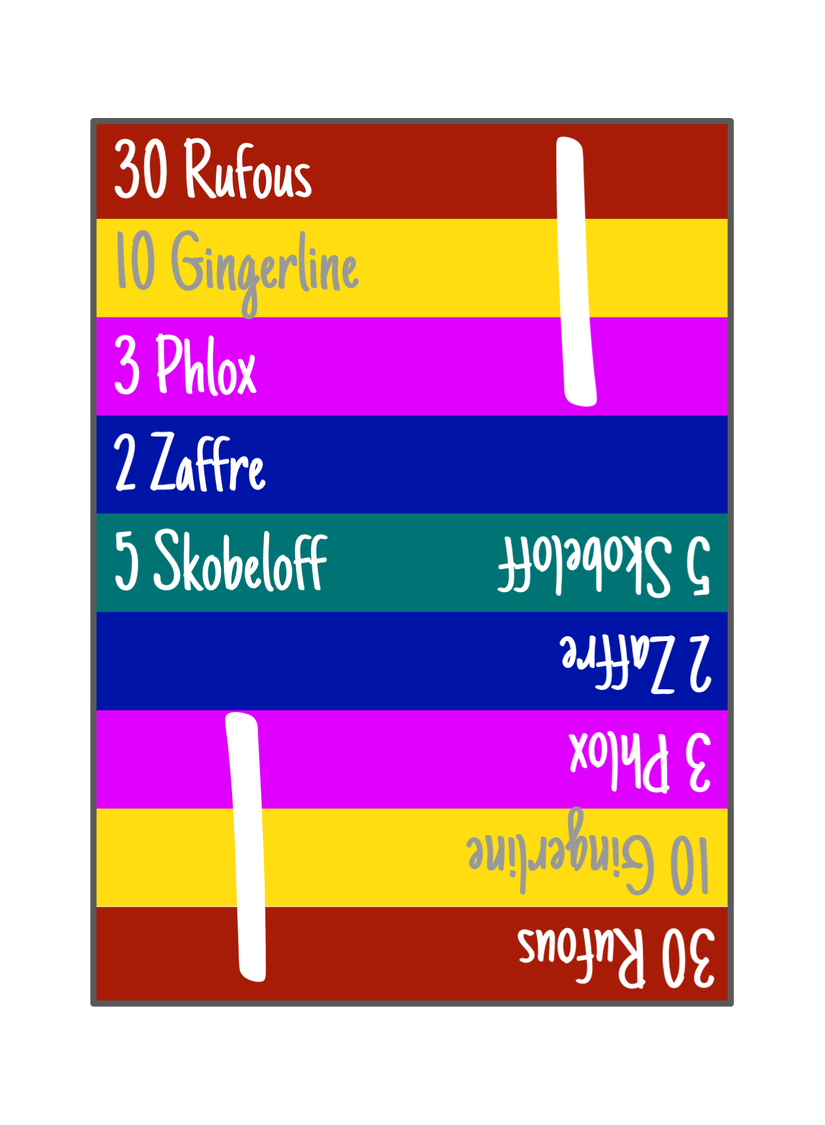
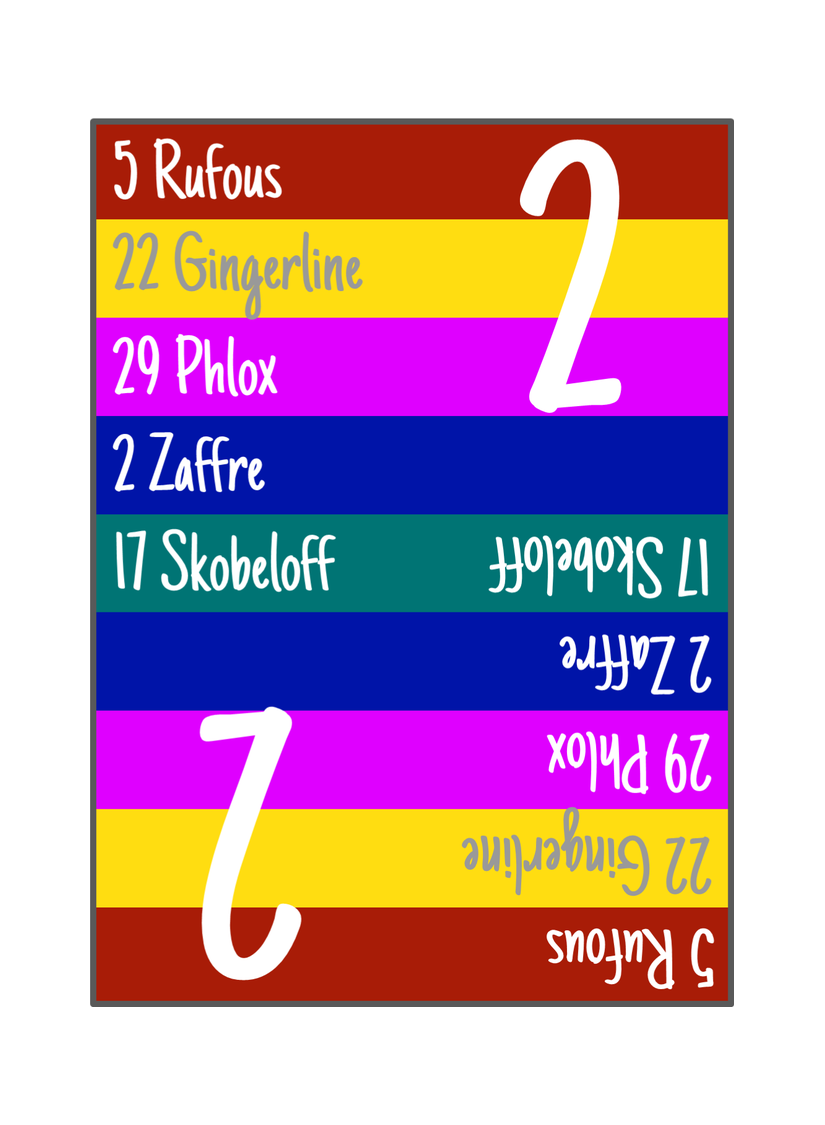
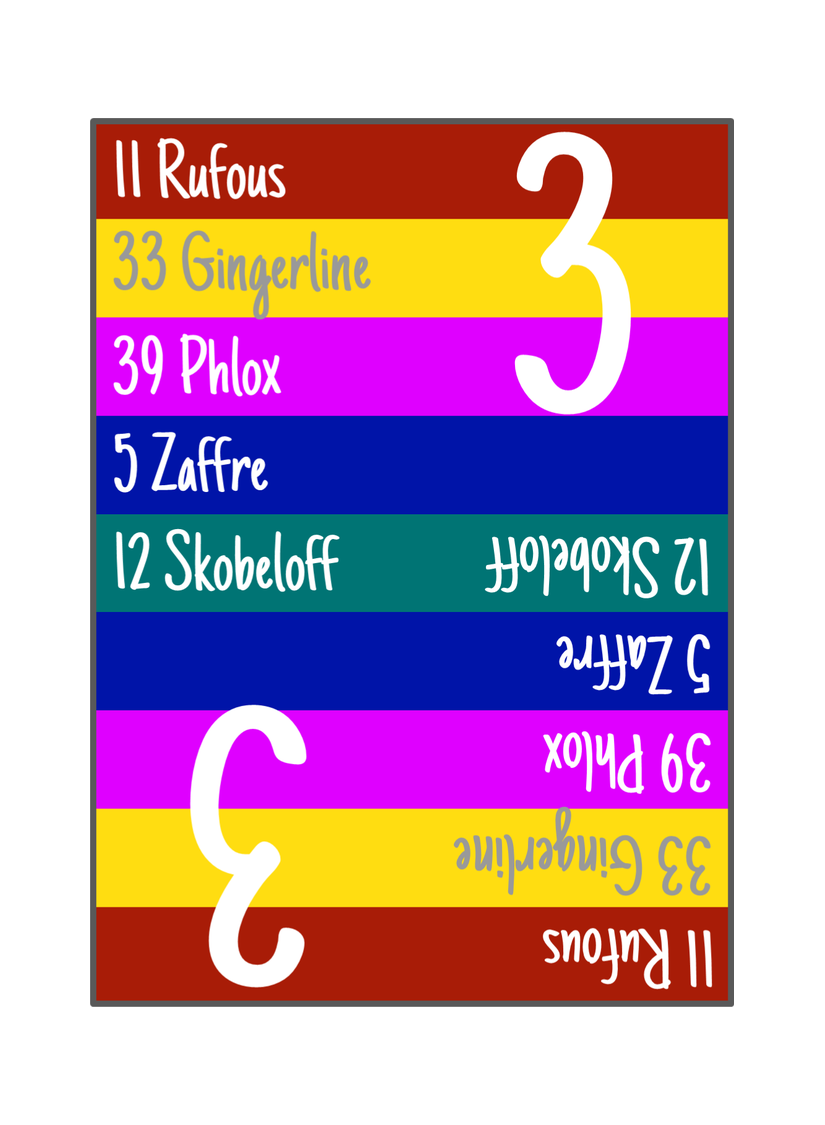
Every card in Lovat is unique. There are three levels of cards, and each level has different parameters:
The numbers on a level one card sum to 50. No number is higher than 30. There are 40 level one cards in the deck.
The numbers on a level two card sum to 75. None are higher than 40. There are 30 level two cards.
The numbers on a level three card sum to 100. None are higher than 50. There are 10 level three cards.
Card Levels
Hover or press and hold to interact.
Questions
If you have read through the rules and can’t find the answer to a question you have about how a certain scenario plays out, fill out our form to ask about the rules.